
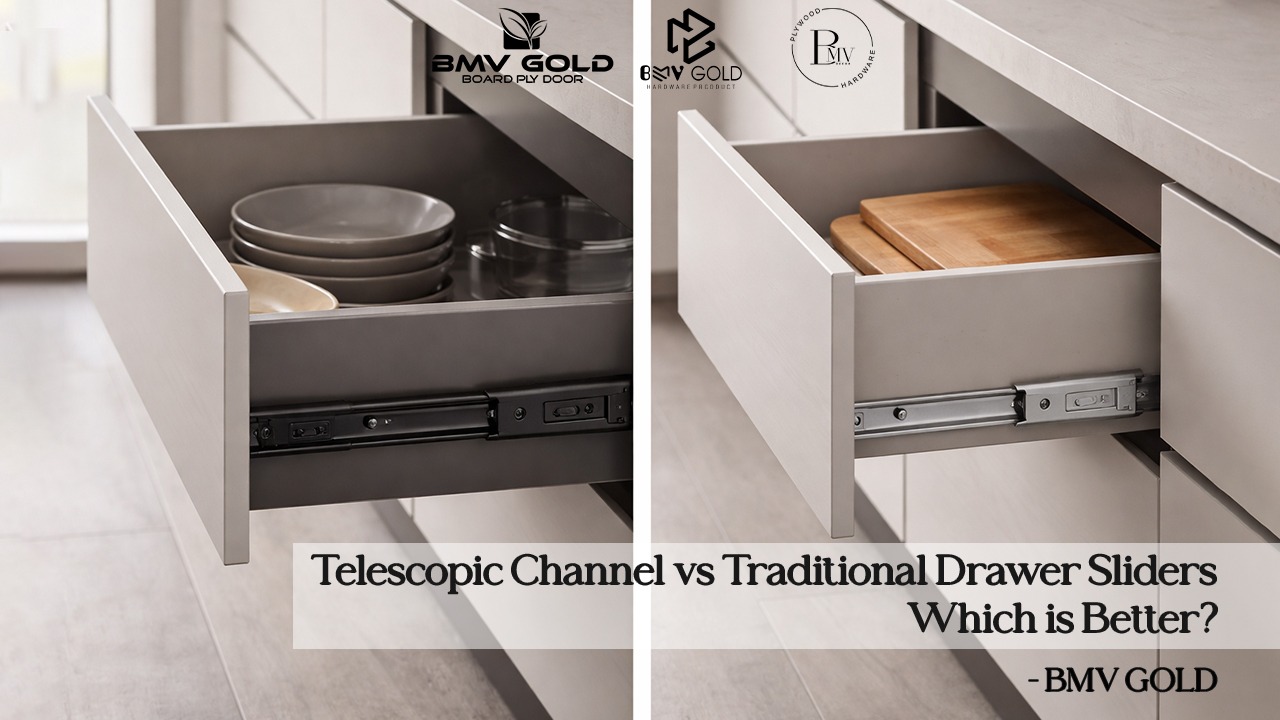
When choosing hardware for modern furniture, the debate between Telescopic Channel for Drawers and Traditional Drawer Sliders is more relevant than ever. Whether you are designing kitchen cabinets, office storage, wardrobes, or commercial furniture, selecting the right drawer mechanism directly impacts durability, smoothness, and overall performance.
In this detailed comparison of Telescopic Channel vs Traditional Drawer Sliders, we will analyze performance, Drawer Slider Load Capacity, durability, cost, and installation factors. If you are searching for the best solution for long-lasting furniture, this guide will help you make the right decision especially if you are considering the premium quality of BMV GOLD Telescopic Channel.
A Telescopic Channel for Drawers is a modern sliding system designed with ball-bearing technology that ensures smooth and silent operation. Unlike older friction-based systems, a telescopic channel allows full drawer extension, giving complete access to stored items. This feature makes it especially useful in kitchens and office storage where accessibility matters. One of the biggest advantages of a Telescopic Channel for Drawers is its superior Drawer Slider Load Capacity, typically supporting between 35kg and 45kg depending on the model.
Another key benefit is durability. A high-quality Telescopic Channel for Drawers is made from corrosion-resistant steel with anti-rust coating, ensuring a longer lifespan even in humid environments. When comparing Telescopic Channel vs Traditional Drawer Sliders, telescopic systems consistently provide smoother functionality, higher strength, and reduced maintenance. These advantages make them a preferred choice for modern furniture manufacturing.
Traditional Drawer Sliders are basic sliding mechanisms usually made from metal runners or wooden guides. They operate on friction rather than ball-bearing technology, which means movement can become rough over time. Although Traditional Drawer Sliders are generally more affordable initially, their performance often declines with extended use.
One of the major limitations of Traditional Drawer Sliders is their lower Drawer Slider Load Capacity. They are not suitable for heavy kitchen utensils, office files, or commercial storage needs. Additionally, they typically offer only partial drawer extension, limiting access to items stored at the back. When evaluating Telescopic Channel vs Traditional Drawer Sliders, it becomes clear that traditional systems may save money upfront but may not provide long-term durability or efficiency.
The comparison of Telescopic Channel vs Traditional Drawer Sliders highlights several performance differences. Telescopic channels operate using precision ball bearings, ensuring smooth, silent, and stable movement. In contrast, Traditional Drawer Sliders rely on direct surface friction, which increases wear and tear over time.
Another significant difference lies in extension capability. A Telescopic Channel for Drawers allows full extension, giving complete visibility and access to stored items. Traditional Drawer Sliders usually allow only 60–70% extension, which reduces convenience. Durability is another factor where telescopic systems outperform traditional ones. When comparing overall value, Telescopic Channel vs Traditional Drawer Sliders analysis strongly favors modern telescopic technology
When selecting drawer hardware, Drawer Slider Load Capacity is one of the most important factors to consider. A high-quality Telescopic Channel for Drawers is designed to handle heavier loads without bending or sagging. This makes it ideal for kitchen cabinets, tool drawers, and commercial furniture applications.
Traditional Drawer Sliders, on the other hand, are better suited for light-duty usage. Their lower Drawer Slider Load Capacity limits their functionality in modern furniture designs. In terms of durability, telescopic systems are constructed from strong steel with anti-corrosion coating, ensuring longer life and better performance. The durability advantage becomes very clear when analyzing Telescopic Channel vs Traditional Drawer Sliders in real-world usage scenarios.
The Drawer Channel Installation Cost is another factor that buyers often consider. A Telescopic Channel for Drawers may have a slightly higher initial installation cost compared to Traditional Drawer Sliders. However, it requires minimal maintenance and provides long-term reliability. Traditional Drawer Sliders may be cheaper at the time of purchase, but they often require adjustments and maintenance due to wear and tear.
From a long-term investment perspective, the Telescopic Channel vs Traditional Drawer Sliders cost comparison clearly shows that telescopic systems offer better value. The reduced maintenance and longer lifespan compensate for the slightly higher Drawer Channel Installation Cost, making telescopic channels a smarter choice.
When investing in a premium Telescopic Channel for Drawers, brand quality matters significantly. The BMV GOLD Telescopic Channel is engineered for high performance, strength, and durability. Designed with precision ball bearings and high-grade steel, it ensures smooth and silent drawer movement even under heavy load conditions.
One of the standout features of the BMV GOLD Telescopic Channel is its superior Drawer Slider Load Capacity, making it ideal for kitchens, wardrobes, office furniture, and commercial applications. Additionally, its anti-rust coating enhances durability in humid environments. Compared to Traditional Drawer Sliders, the BMV GOLD Telescopic Channel provides better stability, smoother sliding, and longer operational life, making it the preferred choice for modern furniture systems.
The comparison of Telescopic Channel vs Traditional Drawer Sliders clearly shows that telescopic systems outperform traditional mechanisms in durability, smoothness, and load capacity. While Traditional Drawer Sliders may appear cost-effective initially, their lower Drawer Slider Load Capacity and maintenance needs reduce long-term value.
For modern furniture applications that demand strength, reliability, and smooth functionality, investing in a premium Telescopic Channel for Drawers such as BMV GOLD Telescopic Channel is the better choice.